MoroccoFood & Drink · Marrakech, Fes and beyond
Moroccan Food: 15 Dishes to Try and How to Eat Like a Local
What to eat in Morocco: tagine, couscous, pastilla, harira, tanjia and street snacks, plus mint tea, table manners, Ramadan eating and what it all costs.

In this guide
Moroccan cooking is one of the great cuisines of the world: slow-cooked stews sweetened with fruit, fragrant with saffron and cinnamon, finished with preserved lemons and olives. Most visitors eat nothing but tagine for a week. This guide covers what else to order, where to find it and how to eat it.
How do you eat in Morocco?
Meals are shared. A tagine or plate of couscous comes to the middle of the table, and everyone eats from their own section. Traditionally you eat with the right hand, using a piece of bread (khobz) as a scoop, though restaurants always offer cutlery.
The main meal is lunch, often not before 1 pm. Friday lunch is couscous day in Moroccan homes. Bread is sacred: don’t throw it away, and don’t be surprised to see leftover bread left carefully on a wall for others.
Tagines and stews
1. Chicken tagine with preserved lemon and olives
The classic. Chicken slow-cooked with ginger, saffron and turmeric in the conical clay pot that gives the dish its name, finished with salty preserved lemons and green olives.
2. Lamb or beef tagine with prunes
Sweet and savoury: meat braised until soft with prunes, cinnamon and honey, topped with toasted almonds and sesame seeds.
3. Kefta tagine
Spiced meatballs in a tomato sauce with an egg cracked on top at the end. Cheap, quick and a favourite lunch in the medinas.
4. Tanjia
The Marrakech speciality. Beef or lamb, preserved lemon, garlic and spices go into a tall clay urn, which is left for hours in the embers of a hammam furnace. Try it at the food stalls on Jemaa el-Fna. Our Marrakech travel guide covers the square.
Couscous and pastilla
5. Couscous with seven vegetables
Steamed semolina piled with vegetables and meat, served with the broth on the side. The knowledge and practices of making couscous are shared by Morocco, Algeria, Mauritania and Tunisia and recognised by UNESCO as intangible cultural heritage.
6. Pastilla (bastilla)
A thin, crisp pastry pie filled with pigeon or chicken, almonds, egg and spices, dusted with icing sugar and cinnamon. Sweet and savoury at once, and a speciality of Fes. Seafood pastilla is a savoury version.
7. Mechoui
Whole lamb slow-roasted in a pit, sold by weight and eaten with salt and cumin. In Marrakech, look for the mechoui stalls in the lanes off the northeast side of Jemaa el-Fna, busiest at lunchtime.
Soups and street food
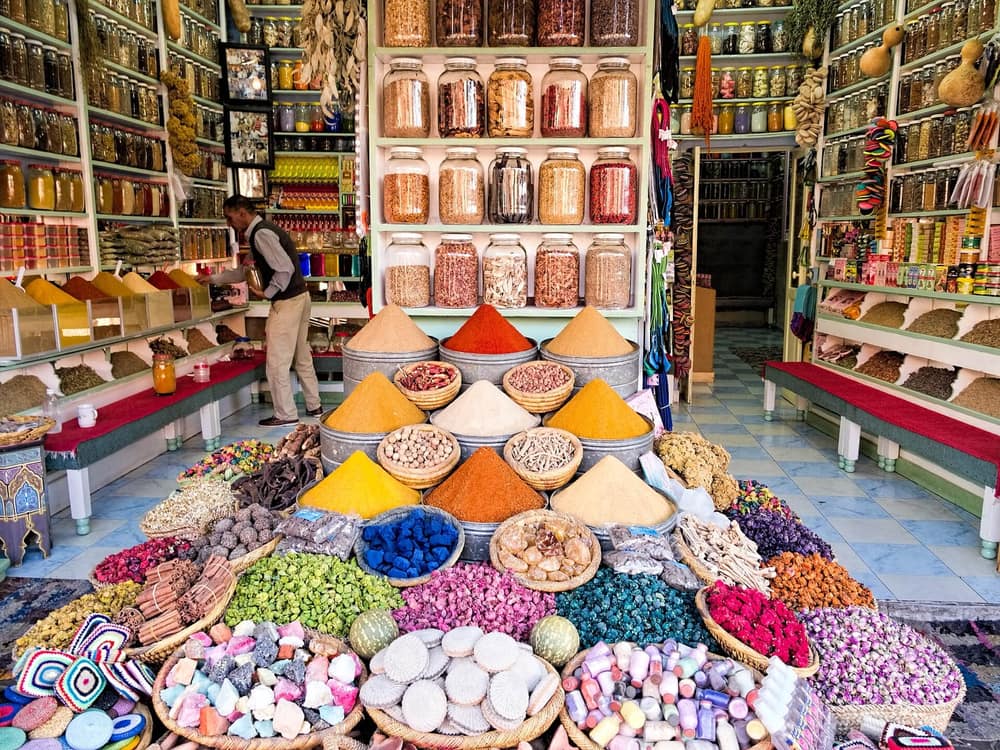
A spice shop in the souks. Photo: Dan Lundberg, CC BY-SA 2.0
8. Harira
A tomato, lentil and chickpea soup with herbs and a little meat, thickened with flour and egg. It’s how the fast is broken during Ramadan, and it’s served all year at stalls and cafes for a few dirhams.
9. Bissara
A thick, cheap fava bean soup drizzled with olive oil, cumin and paprika. A winter breakfast of workers in Fes and the north.
10. Msemen and baghrir
Msemen are square, flaky griddled flatbreads, often served with honey or stuffed with onions and spices. Baghrir are spongy “thousand-hole” semolina pancakes soaked in butter and honey. Both are breakfast staples.
11. Sfenj
Light, ring-shaped doughnuts fried to order by street vendors and sometimes threaded on a palm frond to carry away. Best eaten hot.
12. Grilled brochettes and snail soup
At the evening stalls on Jemaa el-Fna, look for skewers of spiced lamb or chicken and bowls of babbouche, snails in a peppery broth said to be good for digestion.
Sweets and drinks
13. Chebakia and Moroccan pastries
Chebakia are flower-shaped sesame pastries fried and soaked in honey, eaten especially during Ramadan. Pastry shops also sell gazelle horns (kaab el ghazal), crescent-shaped almond pastries.
14. Mint tea
Green tea brewed with a large bunch of fresh mint and plenty of sugar, poured from a height to create foam. It’s offered everywhere as a sign of welcome, including by shopkeepers in the souks. Ask for bla sukkar (without sugar) or shwiya sukkar (a little sugar).
15. Fresh orange juice
The juice stalls on Jemaa el-Fna press oranges in front of you. Choose stalls that squeeze fresh into your glass rather than pouring from a jug.
Where should you eat in Morocco?
- Food stalls on Jemaa el-Fna (Marrakech): numbered stalls grill and fry from dusk. Agree the price of anything not on a posted menu before you sit down.
- Local snack bars and cafes: in both new towns and medinas, where Moroccans eat lunch. Cheap, fast and good.
- Riad restaurants: many riads cook excellent set dinners if you book in the morning.
- Cooking classes: offered in Marrakech and Fes, usually starting with a market visit.
Planning the route? Our 7-day Morocco itinerary passes through the best food cities, and our Morocco travel tips cover alcohol, Ramadan and table manners.
Eating during Ramadan
During Ramadan (expected to begin around 8 February 2027, subject to the moon sighting), Muslims fast from dawn to sunset. Many local restaurants close by day, while hotels and tourist restaurants stay open. At sunset, the ftour (breaking of the fast) starts with dates, milk and harira, and the streets fill with people. It’s a special time to visit, as long as you avoid eating, drinking or smoking in public during the day.
How much does food cost in Morocco?
| Item | Typical price (dirhams) |
|---|---|
| Bowl of harira or bissara | 5 to 15 |
| Msemen or sfenj | 3 to 10 |
| Fresh orange juice on Jemaa el-Fna | 10 to 20 |
| Mint tea in a cafe | 10 to 25 |
| Tagine at a local restaurant | 60 to 120 |
| Dinner at a riad or mid-range restaurant | 150 to 350 |
Our Morocco trip cost breakdown has a full daily budget.
Know before you go
Morocco at a glance
Best time to visit
March to May, September to November
- Capital
- Rabat
- Currency
- Moroccan dirham (MAD)
- Language
- Arabic, Tamazight (French widely used)
- Time zone
- UTC+1 (UTC+0 during Ramadan)
- Plugs
- Type C / E, 220 V
- Driving
- On the right
Emergency19 police, 15 ambulance
Frequently asked questions
What is the national dish of Morocco?
Couscous is often called the national dish, traditionally eaten with family after Friday prayers. Tagine is the dish visitors meet most often, served in almost every restaurant.
Can you drink alcohol in Morocco?
Yes, in licensed hotels, bars and some restaurants, mainly in the big cities and tourist areas, and from a few supermarkets. Many traditional restaurants and most places in the medinas don't serve alcohol. Avoid drinking in public.
Is Moroccan food spicy?
Moroccan food is heavily spiced but rarely hot. Cumin, cinnamon, ginger, saffron and paprika are everywhere; chilli heat usually comes from harissa served on the side.
What do you eat in Morocco during Ramadan?
At sunset the fast is broken with dates, milk and a bowl of harira soup, along with chebakia (honey-soaked sesame pastries), boiled eggs and msemen flatbread. Many restaurants in tourist areas stay open by day, but eat discreetly in public.
Is it safe to eat street food in Morocco?
Generally yes at busy stalls that cook to order. Drink bottled water, and peel fruit or eat it cooked for the first few days if you have a sensitive stomach.
Useful links (2)
- Couscous: knowledge, know-how and practices, UNESCO Intangible Cultural Heritage— ich.unesco.org
- Moroccan National Tourist Office— visitmorocco.com


