Morocco Travel Tips: 20 Things to Know Before You Go
Practical Morocco travel tips for 2026: visas, what to wear, haggling, common scams, money, Ramadan, alcohol, photos, safety and getting around.

In this guide
Morocco is only a short flight from Europe, but it can feel like a different world: the call to prayer, the maze of the medinas, the constant negotiation. A little preparation makes the difference between a stressful trip and a wonderful one. These are the things we’d tell a friend before their first visit.
Before you go
1. Check your entry rules
Citizens of the EU, UK, US, Canada and Australia, among many others, can visit visa-free for up to 90 days. Your passport should be valid for your whole stay; six months’ validity is the safest rule. Other nationalities may be able to apply online through Morocco’s e-Visa system. Always confirm with your government’s travel advice before booking.
2. Pick your season
Spring (March to May) and autumn (September to November) are ideal nearly everywhere. Summer is very hot in Marrakech, Fes and the desert, but pleasant on the Atlantic coast. Winter is mild and sunny by day, but cold at night in the mountains, the desert and unheated riads.
3. Know when Ramadan falls
During the holy month, Muslims fast from dawn to sunset. Tourist services keep running, but many local cafes close by day and life shifts to the evening. Morocco also moves its clocks back one hour for the month. Ramadan 2027 is expected to start around 8 February, subject to the moon sighting.
4. Get travel insurance
Private clinics in the big cities are good but expensive. Make sure your policy covers any trekking at altitude if you plan to hike toward Toubkal.
How does money work in Morocco?
5. The dirham is a closed currency
You can only get Moroccan dirhams (MAD) inside Morocco, and you may take out no more than 2,000 dirhams when you leave. Withdraw from ATMs in cities, and change leftover cash back at the airport before security.
6. Carry small change
Taxis, tea, tips and souk purchases all need small notes and coins. Break big notes at supermarkets and train stations.
7. Budget for tips
Tipping is expected: around 10 percent in restaurants, a few dirhams for small services, and more for guides and drivers. See our Morocco trip cost breakdown for daily budgets.
Culture and etiquette
8. Dress modestly
Loose clothing that covers shoulders and knees is respectful for both men and women, and it’s more comfortable in the sun. Beachwear belongs on the beach. Women may want a light scarf, useful for sun, dust and visiting religious sites.
9. Most mosques are closed to non-Muslims
The main exception is the Hassan II Mosque in Casablanca, which runs guided tours for visitors. Elsewhere, admire mosques from outside and visit madrasas (religious schools) instead.
10. Ask before taking photos of people
Many Moroccans don’t want to be photographed, and performers on Jemaa el-Fna expect payment. Always ask first, and accept “no” gracefully.
11. Learn a few words
A few words of Darija or French go a long way: salam alaykum (hello), shukran (thank you), la, shukran (no, thank you), bshhal? (how much?) and inshallah (God willing), which you’ll hear constantly.
12. Use your right hand
The right hand is used for eating, greeting and passing things. When sharing a tagine, eat from the section in front of you.
The souks and haggling
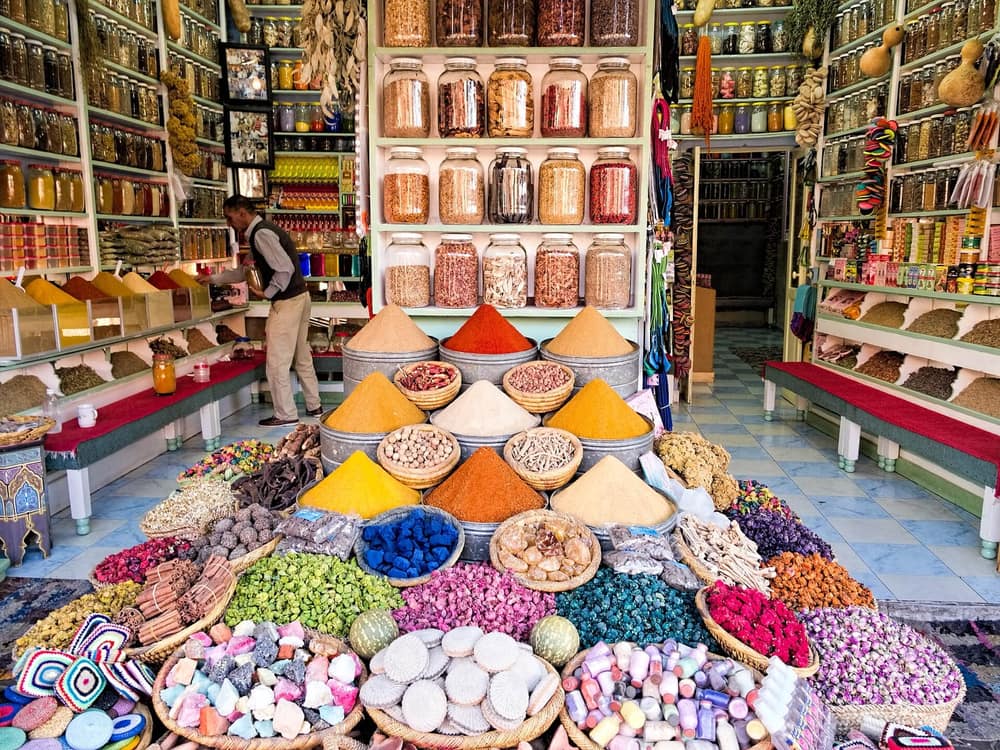
A spice shop in the souks. Photo: Dan Lundberg, CC BY-SA 2.0
13. Haggle, but only if you want it
Prices in the souks are a starting point. Don’t start negotiating unless you’d buy at some price. Decide what it’s worth to you, offer well below the first price, and meet somewhere in between. If it doesn’t work, say thank you and walk away; you’ll often be called back.
14. Accepting mint tea doesn’t oblige you to buy
Shopkeepers often offer tea. It’s hospitality and sales at once. Enjoy it, and you’re still free to leave without buying.
15. Fixed-price shops exist
If haggling isn’t for you, look for fixed-price stores and artisan cooperatives. In Marrakech, the Ensemble Artisanal near the Koutoubia is a useful reference for fair prices.
What scams should you watch for in Morocco?
16. “The square is closed” and other tricks
The most common scams in Marrakech and Fes:
- A friendly stranger tells you the road ahead is closed, or “the tannery is this way”, then leads you to a shop or demands payment.
- Someone gives unrequested directions and then asks for money.
- A henna artist grabs your hand and starts before agreeing a price.
- Someone takes a photo with you holding a monkey or snake, then demands a large fee.
Keep walking, use a map app, and say a firm, polite “la, shukran”.
17. Use official guides in the medinas
In Fes especially, a licensed guide for the first half-day is worth it. Official guides carry ID badges, and your riad can book one.
18. Watch your belongings
Pickpocketing happens in crowds, especially on Jemaa el-Fna in the evening. Carry a small cross-body bag, and leave your passport in the riad safe.
Getting around
19. Take the train between cities
ONCF trains are comfortable and cheap. The Al Boraq high-speed line runs Tangier to Casablanca in just over two hours, and conventional trains continue to Marrakech and Fes. For places the train doesn’t reach, CTM and Supratours buses are reliable.
20. Agree taxi fares or insist on the meter
Petit taxis work within cities and carry up to three passengers; ask for the meter (compteur) or agree a price before you get in. Grand taxis are shared between towns and leave when full. For the Sahara, most travellers take a tour; see our 7-day Morocco itinerary.
Plan your trip
Start with our Marrakech travel guide, then work out what to eat with our Moroccan food guide.
Know before you go
Morocco at a glance
Best time to visit
March to May, September to November
- Capital
- Rabat
- Currency
- Moroccan dirham (MAD)
- Language
- Arabic, Tamazight (French widely used)
- Time zone
- UTC+1 (UTC+0 during Ramadan)
- Plugs
- Type C / E, 220 V
- Driving
- On the right
Emergency19 police, 15 ambulance
Frequently asked questions
Do I need a visa for Morocco?
Citizens of the EU, UK, US, Canada, Australia and many other countries can visit Morocco visa-free for up to 90 days. Your passport should be valid for your whole stay, and six months' validity is the safest rule. Other nationalities may be able to use Morocco's e-Visa system. Check the rules for your passport before booking.
Is Morocco safe for solo female travellers?
Many women travel solo in Morocco without problems, but street harassment, mostly verbal, is common in the medinas. Dressing conservatively, walking with purpose, ignoring comments and staying in well-reviewed riads all help. Joining a small group tour for the desert is a good option.
Can you drink alcohol in Morocco?
Yes, in licensed hotels, bars and restaurants and from a few supermarkets, mostly in larger cities. Public drinking isn't acceptable, and alcohol is harder to find during Ramadan.
What language is spoken in Morocco?
The official languages are Arabic and Tamazight (Berber). Most Moroccans speak Darija, Moroccan Arabic, day to day. French is widely used in business, menus and signs, and English is common in tourist areas.
Is it OK to visit Morocco during Ramadan?
Yes. Most tourist services keep running, and the evenings after the fast is broken are festive. Many local cafes close during the day and some sights keep shorter hours. Avoid eating, drinking or smoking in public in daylight. Ramadan 2027 is expected to begin around 8 February, depending on the moon sighting.
Useful links (4)
- Morocco travel advice, US State Department— travel.state.gov
- Foreign travel advice: Morocco, UK government— gov.uk
- Morocco to return to GMT for Ramadan, Morocco World News— moroccoworldnews.com
- Moroccan National Tourist Office— visitmorocco.com


